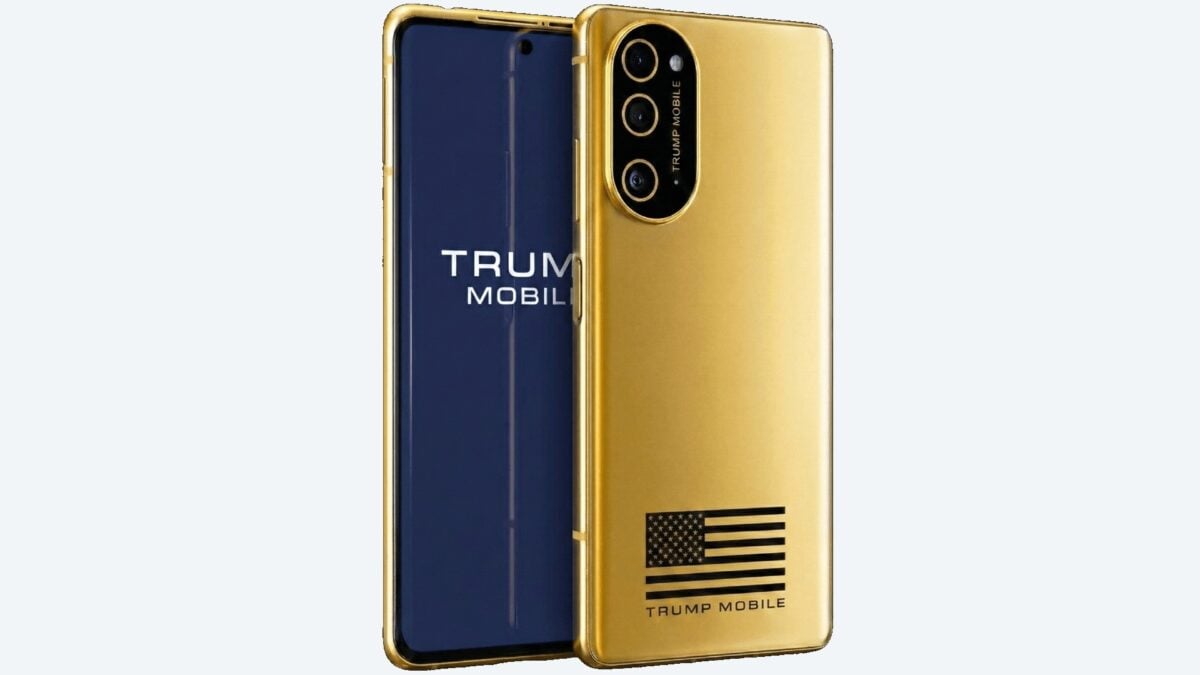
Ask yourself this: do we need another gold phone with a political logo? The Trump Organization's consumer-facing arm, Trump Mobile, has quietly updated its site with a redesigned T1 handset — the so-called "Trump Phone" — and while the new images are clearer than earlier mockups, they raise almost as many questions as they answer.
Same gold, new spacing, familiar uncertainty
The refreshed visuals keep the phone's unabashed gold finish and an American-flag motif on the back, though the garish, all-caps "T1" plastered across earlier renders reportedly has been removed. The rear shows three vertically stacked cameras with an odd spacing, a curved edge to the chassis, and — yes — a headphone jack at the top. Observers have noted the overall silhouette resembles phones like the HTC U24 Pro, rather than a bespoke industrial masterpiece.
Specs listed on the site (and shown to reporters in earlier video calls) read like a competent mid‑range device on paper: a 6.78‑inch OLED display, a 5,000mAh battery with 30W charging, a 50MP main sensor paired with an 8MP ultra‑wide and a 50MP telephoto (2x), a 50MP selfie camera, Android 15, 512GB of storage and an unspecified Qualcomm Snapdragon 7‑series chip. The site also posts a "promotional" starting price of $499 and asks for a $100 deposit to lock that rate.
That price and spec sheet tell part of the story — but not the whole thing. For one, Trump Mobile still won't specify the exact chipset, and no credible hand‑on reviews or independent teardowns have appeared. In short: the phone looks real in photos and video, but no journalist (at least none the industry trusts) has held a retail unit.
Production, branding and politics
Trump Mobile's earlier marketing leaned on "Made in the USA" messaging; the site has quietly softened that to phrases like "designed by American innovation" and "an American team leads the design and quality," a subtle change that echoes the practical reality most phone makers face. Building a modern smartphone almost entirely from U.S. components is, as supply‑chain experts have pointed out, basically impossible at scale.
There are other formal breadcrumbs suggesting more than a press stunt: FCC filings tied to a device labeled "T1" have surfaced, and trademark activity — including a recent filing for a name invoking Donald Trump as the 47th president — indicates ongoing commercial intent. Still, regulatory paperwork and trademarks don't guarantee a launch; they just mean someone is doing the paperwork.
Who's this for — and will they buy it?
Skepticism is the reasonable response. Commentators have mocked the styling and questioned demand. Even supporters might pause at a midrange Snapdragon chip bundled with an unusually large 512GB of storage and a price that lands in impulse territory for collectors but risks being outcompeted on value by mainstream brands that offer proven build quality and after‑sales support.
This isn't the first time a nontraditional tech player has tried to make a splash with hardware aimed at a niche audience. Big companies have tried the same — some leaning their devices toward commerce or voice assistants — and those efforts reveal how tricky execution is when hardware meets corporate strategy. See how another retail‑minded firm approached its device push in the case of Amazon’s Transformer Phone Is About Alexa — and Shopping, Again.
And for anyone wondering whether prototypes and supply chains can derail enthusiasm, look no further than the messy life cycle of ambitious form factors and prototypes: lessons from inside the LG rollable prototype still resonate.
The family-business angle
The Trump family is visibly leaning into the product: promotional pages now feature Donald Trump Jr. and Eric Trump, and a new site video shows both sons prominently. The main page even displays a network name reading "Trump" in the status bar imagery — a flourish meant for supporters, and a bit unnerving to critics.
With the release date omitted and earlier "launch later this year" language removed, the T1 sits somewhere between concept and product. If Trump Mobile does ship, it will be marketed as more than a phone: a political artifact, a brand play, and a test of whether a phone can double as campaign merch — all in one shiny gold package.
For now, the T1 is a near‑real object in photos and filings, a promise on a website, and an open question in the market. Whether it becomes a collectible, a mainstream purchase, or a footnote depends on whether anyone beyond the company can verify that it actually performs as promised — and whether buyers will pay for the politics as much as the pixels.